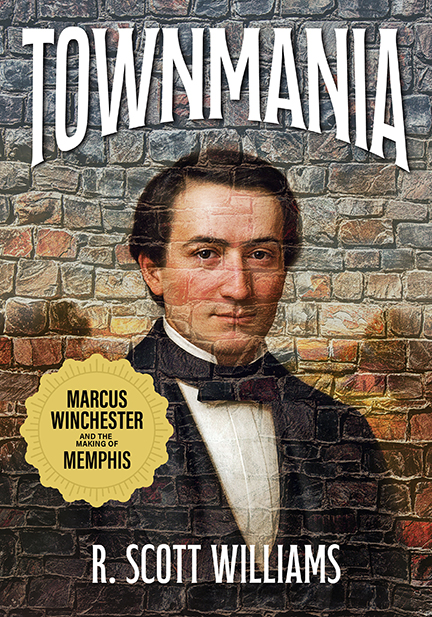
Here is the introduction to my new biography of Marcus Winchester, now available in hardcover, softcover, and e-book editions in select bookstores and on Amazon.com.
On the episode of the game show Jeopardy! that aired on Christmas Day 2024, the final clue came from the category “U.S. Place Names.” As the contestants held their breath, host Ken Jennings read the clue: “A trio including Andrew Jackson founded this city with a name that evokes a great city of the ancient world.” Among the contestants was returning champion Laura Faddah, who was in second place heading into Final Jeopardy. To guarantee her spot in the Tournament of Champions, she needed a fifth consecutive win. The clue proved to be a perfect Christmas gift—Faddah is a native of Memphis, Tennessee, so she confidently answered correctly and secured her victory.
John Overton, James Winchester, and Andrew Jackson have been recorded in the annals of history as the trio of founders of Memphis, Tennessee. However, Winchester and Jackson had only small financial investments in Memphis; Jackson, who likely never even visited, only had his investment for a short time. Overton was the financial mastermind behind the land deal, and all three saw it as nothing more than that—a way to make a profit, then get out. Only one man—really just a boy at the time—Marcus Brutus Winchester, envisioned it as a community where thousands would one day live, work, and play.
In the summer of 1851, Marcus Winchester was answering questions of his own, but this was no game show. He was testifying in the case of The Mayor and Aldermen of South Memphis v. Wardlow Howard and Joseph Kent, a case concerning the intentions of the original proprietors for use of the riverfront, or promenade, as they called it.
Winchester was born on May 28, 1796—four days before Tennessee became a state—so, like the state, he was fifty-five at the time. Life on the Mississippi River was not conducive to longevity, so Winchester was among the oldest residents in the county and one of the few original settlers still living at the time.
After reading the transcripts from that day, James H. Malone, Memphis mayor from 1906 to 1910, proclaimed, “The intelligence of Maj. Winchester cannot be better illustrated than his capacity in cleancut English to recite the early history of Memphis.”
Those who met Winchester frequently described him using adjectives such as sophisticated, polished, well-dressed, and handsome. Early historian James Davis wrote that during Winchester’s time as a prisoner of war, he “attracted a great deal of attention for the remarkable beauty of his features and figure.” Davis added that English tourists who met young Winchester wrote letters home that were “lavish in their praise for the “little Yankee Major.’” Writer Frances Trollope claimed Winchester was “the only gentleman west of the Appalachians,” while her friend Francis Wright described him as “a pleasing, gentlemanlike man” who seemed “strangely misplaced in a little town on the Mississippi.”
All eyes were on him in the courtroom in 1851 as he cleared his throat and began:
I settled in Memphis, then known as the Chickasaw Bluff, in the year 1819, I believe in the month of May as one of the agents of the proprietors of the John Rice 5,000-acre grant. The town of Memphis was laid off in that year. The surveys may not have all been completed until the latter part of that year or the spring of the following year. The engraved plan marked X with the name of E. S. Todd written thereon was made under the direction of the Proprietors and published in the year 1820. I believe it to be a mainly correct plan of the town as then laid off.
Everyone in the courtroom that day knew Marcus Winchester was the true founder of Memphis. As one writer put it in 1855, “As a citizen of Memphis, there is no person living so closely identified with its interests and prosperity, and the history of one could not be written without the other.”
As the son of Brigadier General James Winchester, Marcus grew up among the privileged and wealthy early Americans at Cragfont, one of the first mansions on the Tennessee frontier. He was sent east for his education where he lived with his father’s notable family in Baltimore, Maryland. As a teenager, Winchester left school and joined his father as an unofficial aide-de-camp serving in the War of 1812. He was captured, along with his father, in a conflict that resulted in the greatest number of Americans killed in a single battle during that war. Winchester watched as the reputation of his father, who had been a hero in the Revolutionary War, was tarnished beyond repair.
At just twenty-two, Marcus Winchester was there during a pivotal moment in the settlement of West Tennessee. In 1818, he joined Isaac Shelby and Andrew Jackson at the negotiation and signing of a treaty with the Chickasaw Nation that came to be known as the Jackson Purchase. This historic agreement opened approximately eight million acres of land—spanning present-day West Tennessee and Southwest Kentucky—for American settlement. It also marked a significant step in westward expansion. Long before the treaty, a portion of that land had already been titled to James Winchester, Andrew Jackson, and one of Jackson’s closest friends and political allies, John Overton. Overton would become one of Winchester’s biggest mentors, although frequently the two did not see eye to eye.
Immediately after the treaty was signed, the proprietors, as they were called, sent Marcus Winchester to create a town on the fourth Chickasaw bluff that could be divided into lots and resold at a profit. It was a task he could have quickly completed then returned to Nashville, near where his parents lived, or to Baltimore, where he had been educated and where his extended family resided. He could also have moved to New Orleans, where his father often conducted business and other family members had settled. Instead, he chose to make Memphis home for the rest of his life. Young Winchester found himself living among a rugged yet enterprising mix of flatboat crewmen, Native Americans, fur trappers, and traders—all eking out a living on the bluff that his father, Brigadier General James Winchester, soon named Memphis.
In addition to helping lay out the streets and greenspaces—some of which remain in their original locations today—he created the first map of Memphis and sold the city’s first lots. He was selected as the first mayor, opened the first store, facilitated the first bank, handled the construction of the first courthouse and jail, and was the first postmaster. Knowing transportation was key to the growth of any city, Winchester championed the first ferry that crossed the Mississippi River on a regular basis, the first major roads east and west, and the first train tracks that were laid in the Midsouth. It was also Winchester the people of early Memphis could thank when the first pages of The Memphis Advocate and Western District Intelligence, the town’s first newspaper, rolled off the press.
Applying a combination of creativity, diplomacy, and strong business acumen, Winchester guided the transformation of a sparsely populated outpost on the Mississippi River into a thriving commercial hub. Driven by the cotton industry, his little town then became one of the most important cities in the American South.
Through it all, he had to manage the complicated relationships that formed between those of different races including Native Americans, enslaved and free Black individuals, White enslavers, and abolitionists. His father, an early Tennessee settler, was an Indian fighter, and Marcus’s uncle had been murdered and scalped. Marcus Winchester conducted business on the bluff with Native Americans and, by all accounts, showed respect for their culture. However, he also owned several ferries used in Memphis during the Cherokee Trail of Tears and other forced relocations, where Native American men, women, and children were displaced and transported west against their will.
Winchester also had to navigate the complicated relationships between Black and White individuals that existed in the earliest years of slavery in the South. Although he was raised on a plantation where the enslaved were forced to work both inside and outside the house—and he was an enslaver himself—he assisted other enslavers in navigating the legal system to free many enslaved men, women, and children. He also ran one of the few banks that the enslaved could use to save money to purchase their freedom or that of their loved ones. Race became especially personal for Winchester when he married Amarante Loiselle, a woman of mixed race from a land-owning free family in St. Louis. Together, they had eight children. The racism directed at him and his family culminated in the passage of a city ordinance that stated no White man could “keep a colored wife.” This forced them to live outside the city limits of the town he had founded and faithfully served. The animosity he experienced because of his marriage to a free woman of color is especially ironic today, considering recent discoveries by his descendants: it is likely that Winchester was the great-great-grandson of Gideon Gibson Sr., a free Black landowner from North Carolina.
Great personal and professional losses in Winchester’s later years were met with resilience and tenacity. He experienced the deaths of many close friends, a beloved daughter, and his wife, Amarante. Then, politics cost him his job as postmaster. He owned a significant amount of land in Memphis and across the river in Arkansas, but then lost it all in the bursting of the real estate bubble following the Panic of 1837.
With his second wife, Lucy, at his side, Winchester started over founding the Hopefield Real Estate Company, serving as a Tennessee State Legislator, and working to bring a railroad to Memphis. The story of Marcus Winchester embodies the profound dualities that defined the early Antebellum South. He fought for liberty and freedom when very little of either existed for women or free and enslaved Black individuals. He bravely chose to live life as a settler of the fourth Chickasaw bluff then worked to turn it into a transportation powerhouse. He had a front row seat during the Jackson-era fight over how the country would be governed—limited federal government and greater state sovereignty or an active federal government to promote economic development and modernization. Always diplomatic, he somehow embraced both simultaneously and had friends on all sides.
Winchester was the first Memphian to advocate for safe and reliable ferry service, the construction of wharfs to accommodate all types of boats along the riverfront, and the development of roads to facilitate the transport of goods and people into Memphis. He also laid the foundation for the city’s first railroads.
Today, the Greater Memphis Chamber of Commerce proclaims Memphis is the “Supply Chain Capital of the World,” a testament to the city’s success in the “river, rail, road, and runway” sectors. As the home of FedEx Corporation, Memphis boasts the busiest cargo airport in the nation and the second busiest in the world, trailing only Hong Kong International Airport. The city is also the third busiest trucking corridor in the United States and, thanks to the Mississippi River, ranks as the fifth largest inland port. Railroads continue to play a vital role, with Memphis standing out as one of the few places in the country where five major freight rail companies converge. The seeds of that success were planted by Marcus Winchester.
When he died on November 2, 1856, at age sixty, his obituaries included words like charitable, warm, sympathizing, and chivalrous. Although, the comment he likely would have appreciated the most acknowledged he was working right up until the very end. The reporter wrote, “he died with his harness on.”
After his death, Winchester was buried in the cemetery on land he had donated to the city, then was quickly forgotten. Around 1892, the city stables were unceremoniously built atop his unmarked grave. In the words of the late historian James Roper: “Perhaps Memphis and Tennessee owe him a bit more than has been acknowledged.”
Hopefully, this biography will, in a small way, help acknowledge the debt we Tennesseans owe Marcus Winchester.
“Townmania: Marcus Winchester and the Making of Memphis” is now available in hardcover, softcover, and e-book editions in select bookstores and on Amazon.com.
***
Introduction Endnotes: The following notes reproduce the full references for this chapter. For corresponding reference points in the text, please consult the print edition.
James H. Malone, “History of Early Land Grants for Public Purposes in Memphis,” Commercial Appeal, March 21, 1915.
James D. Davis, History of Memphis (Memphis: Hite, Crumpton & Kelly, 1873), 2.
Davis, History of Memphis, 2.
Alice J. G. Perkins and Theresa Wolfson, Frances Wright, Free Enquirer: The Study of a Temperament (New York: Harper & Brothers, 1939), 144.
Marcus Winchester, Deposition, September 15, 1851, The Mayor and Aldermen of South Memphis v. Wardlow Howard and Joseph Kent, Benjamin L. Hooks Central Library, Memphis and Shelby County Room.
E. R. Marlett and W. H. Rainey, Rainey’s Memphis City Directory, 1855 (Memphis: D.O. Dooley & Co., 1855), 27.
“Death of Major Winchester of New Orleans,” New Orleans Times-Picayune, November 11, 1856.
James E. Roper, “Marcus Winchester and the Earliest Years of Memphis,” Tennessee Historical Quarterly 21, no. 4 (1962): 351.